Lumphini Park monitor lizards: where to see Bangkok's water monitors
Wild water monitors downtown, with the birds, turtles and fish that share their lakes.
On this page
The Lumphini Park monitor lizards are Bangkok’s best-known wild animals: Asian water monitors that swim in the lakes, cross the lawns and bask on the banks of the city’s first public park on Rama IV Road. The park is free, open daily from 04:30 to 22:00 and a short walk from MRT Silom, MRT Lumphini and BTS Sala Daeng. This guide covers when to look, what else lives there, how to keep a safe distance, and two more green spaces where water monitors are easy to see.
At a glance
| Park | What you may see | Hours | Entry | Nearest stations |
|---|---|---|---|---|
| Lumphini Park | Water monitors, pond herons, egrets, turtles, fish | 04:30-22:00 daily | Free | MRT Silom, Lumphini; BTS Sala Daeng |
| Benjakitti Forest Park | Water monitors, kingfishers, wetland birds | 04:30-22:00 daily | Free | BTS Asok; MRT Sukhumvit |
| Sri Nakhon Khuean Khan Park | Forest birds, turtles | 05:00-19:00 daily | Free | Ferry from Wat Khlong Toei Nok Pier |
Lumphini Park: getting there
Lumphini Park sits on Rama IV Road in Pathum Wan. The Bangkok Metropolitan Administration (BMA) lists it as open every day from 04:30 to 22:00 with free entry. Take the MRT to Silom or Lumphini, or the BTS to Sala Daeng and cross Rama IV Road on the Sky Walk.
The park covers 360 rai, according to Time Out Bangkok, and has a 2.5 km jogging loop. Facilities listed by the BMA include a playground, pedal boats, kayaks and paddleboards on the lake, toilets and lockers. Cycling is allowed only from 10:00 to 15:00.
Meet the water monitors
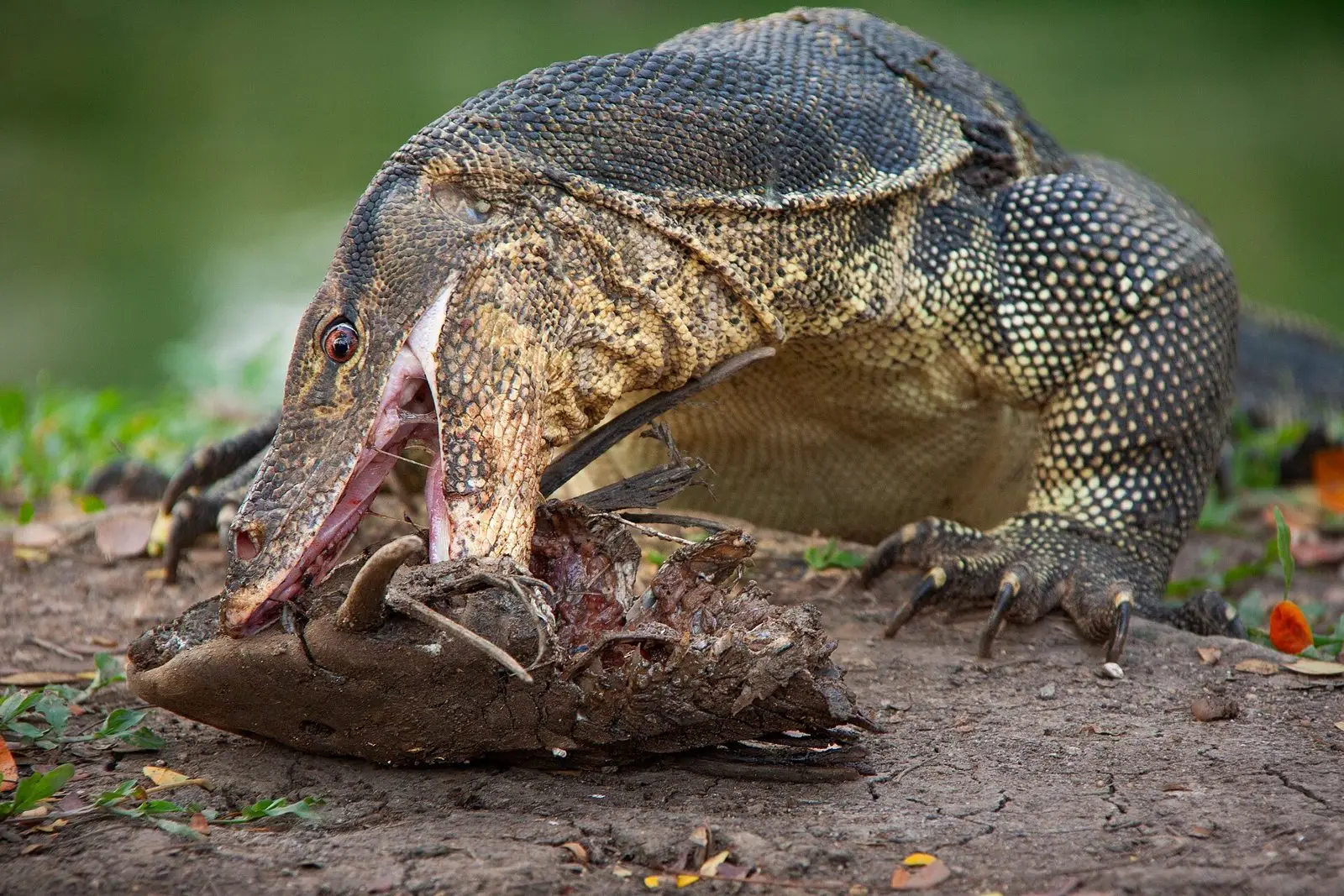
Bangkok’s monitors are Asian water monitors (Varanus salvator), large semi-aquatic lizards that can reach about 3 metres. A March 2026 report by dpa said thousands live along the city’s canals and probably hundreds in Lumphini Park alone. Michael Cota, a reptile expert at Thailand’s National Science Museum, told dpa that their density in Bangkok is far higher than anywhere in the wild.
They are meat-eaters and scavengers that eat fish and carrion, and the larger ones will eat smaller monitors. They swim with side-to-side sweeps of a flattened tail and flick a forked tongue. In the wild in Thailand they are shy; in Lumphini they sunbathe on the lawns and pay walkers and yoga classes little attention, as Time Out Bangkok put it.
The park has embraced them. In April 2025 a giant monitor lizard statue, donated to the BMA by Seacon Square after an event, went on temporary display in the park, Daily News reported.
When and where to look
Early morning is the best time, when monitors forage before the heat, though they can be seen at almost any hour. Walk the lake edges and the bridges over the park’s canals and ponds, and look for basking lizards on the banks and swimming heads in the water.
The cool season, from November to February, makes a morning walk easier. The thaibirding.com Lumphini guide recommends arriving before about 09:00, when the park is cooler and quieter.
Other wildlife in Lumphini Park
The lake and ponds hold turtles and large numbers of fish. Visitors have fed the fish for years; dpa reported that the resulting surplus means the monitors eat far more than they would in the wild.
Birds are the other draw. Residents named by thaibirding.com include coppersmith barbets, Indochinese rollers, Malaysian pied fantails, sunbirds, little egrets and Javan pond herons. In winter, leaf warblers feed in the trees and taiga flycatchers turn up near the ponds. Our birdwatching in Bangkok guide has more on the cool-season migrants.
Water monitors in Bangkok: the relocations
The lizards have not always been welcome. In September 2016 park staff caught nearly 100 monitors, luring them out of the water with catfish, and the city said they would be resettled at a wildlife sanctuary in Ratchaburi province, AFP reported. Officials said the animals were damaging plants and frightening visitors, and that some would stay in the park.
In September 2018 the then governor told The Nation that the BMA had moved 150 large monitors in 2016 and another 150 that year, out of an estimated 400. The dpa report said the removals did not work as planned: with the largest lizards gone, more young survived, and the park again has large numbers.
Benjakitti Forest Park wildlife
Benjakitti Forest Park, near Sukhumvit Road, covers 450 rai of lakes and wetland. The BMA lists it as open daily from 04:30 to 22:00, with a 1.6 km elevated skywalk, a 5.8 km nature trail and cycling from 06:00 to 17:30. Entry is free, according to Thailand Magazine.
A birding guide updated in December 2025 says water monitors are easy to see there. Its lake and reeds also hold collared and white-throated kingfishers, Javan pond herons, white-breasted waterhens and greater coucals. Take the BTS to Asok or the MRT to Sukhumvit; a greenway also links the park with Lumphini.
Sri Nakhon Khuean Khan Park, Bang Kachao
For a quieter, greener setting, cross the river to Bang Kachao in Phra Pradaeng. Sri Nakhon Khuean Khan Park opens daily from 05:00 to 19:00 with no entrance fee, according to a travel guide updated in October 2026, and has more than 100 recorded bird species and a bird-watching tower above the canopy.
Ferries leave Wat Khlong Toei Nok Pier from 06:00 to 20:00 for 10-20 baht each way, and bicycles can be hired near the piers. Our Bang Krachao with kids guide covers the crossing in more detail.
Keeping your distance
The BMA’s posted rules for Lumphini ban drones, smoking, alcohol, gambling, trading and damaging trees. For the lizards themselves, the advice from experts is simple. Cota told dpa that the animals “should never be touched”, and that a monitor inflating its throat is warning you to move away.
- Watch from a few metres away and never block a lizard’s path to the water.
- Do not touch, chase or corner a monitor, and keep dogs away.
- Do not feed the lizards; watching rather than feeding is the welfare-aware choice.
- Cyclists should watch for lizards crossing paths during the cycling hours.
- Take your rubbish home: monitors search bins and bottles for food.
More wildlife guides
For zoos, aquariums and sanctuaries as well as parks, see our guide to where to see animals in Bangkok. For coastal wildlife, try mangrove forests near Bangkok, or browse the Animals section.
Sources
- BMA Greener Bangkok: Lumphini Park, hours, entry, getting there, facilities and park rules (Thai)
- BMA Greener Bangkok: Benjakitti Park, hours, size, skywalk, routes and park rules (Thai)
- The Star (dpa): Monitor lizards, the giants of Bangkok's urban jungle (31 March 2026)
- Time Out Bangkok: Lumphini Park turns 100 this year (25 July 2025)
- Phys.org (AFP): Bangkok's monitor lizards moved out of Lumphini Park (20 September 2016)
- The Nation: Should 'hia' go or should they stay in Lumpini Park? (4 September 2018)
- Daily News: a giant monitor lizard statue at Lumphini Park, donated to the BMA (29 April 2025, Thai)
- Theo Courant: Lumpini Park, wildlife, greenway and practical information (December 2025)
- thaibirding.com: Lumphini Park birding guide (updated February 2022)
- Birdingplaces: Benjakiti Park, water monitors and birds (updated December 2025)
- Thailand Magazine: Benjakitti Park, free entry and the skywalk
- thaibirding.com: Benjakitti Park birding guide (updated March 2026)
- Bucketlistly: Bang Krachao travel guide, park hours and ferries (updated October 2026)