Dugongs in Thailand: latest count, where they live and how to see them
Trang holds half of the country's sea cows, and the count is falling
On this page
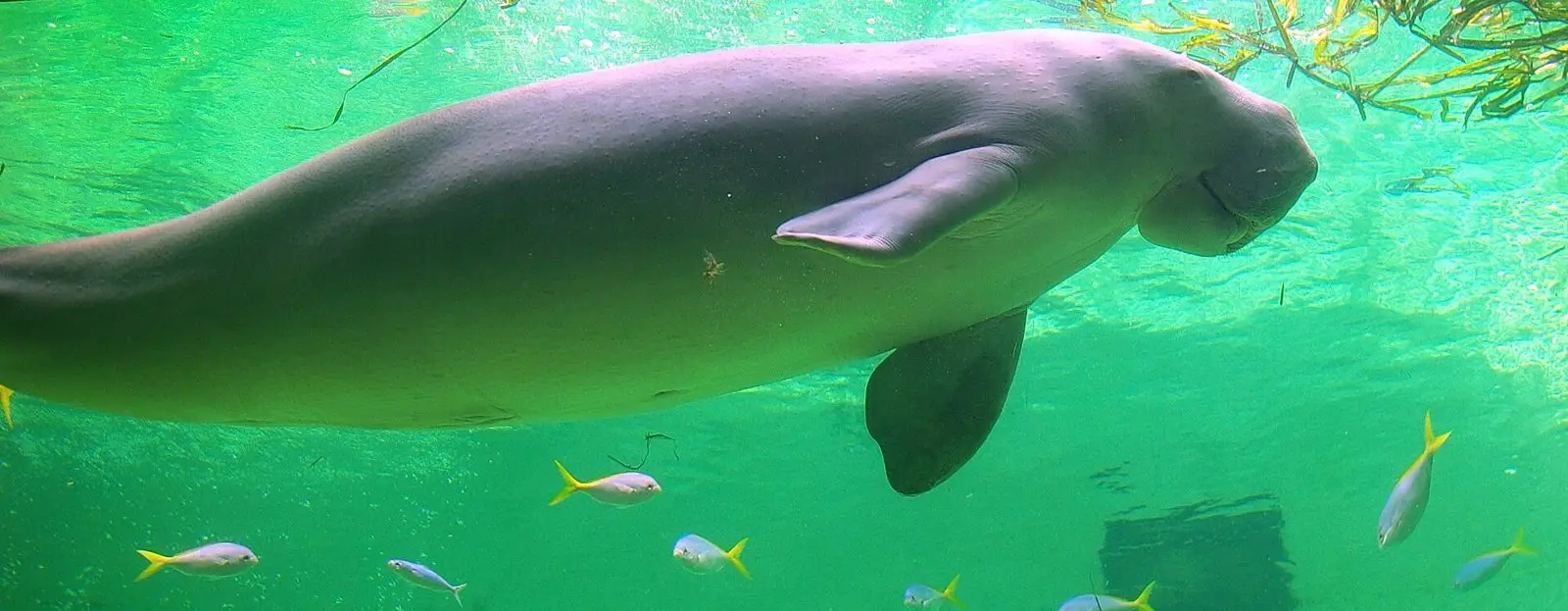
Dugongs in Thailand number 267, according to the latest official count from the Department of Marine and Coastal Resources (DMCR), published in July 2026 with figures for 2024. More than half of them live in the seagrass meadows off Trang, around Koh Libong and Koh Mook, and a small group still feeds in the eastern Gulf between Chon Buri and Trat. This guide covers the numbers, where the animals live, the new rules to protect them and how to watch them without causing harm.
At a glance
| Dugongs in Thailand | |
|---|---|
| Latest count | 267 (2024 figures, published by DMCR on 23 July 2026) |
| Largest population | Trang, 138 animals |
| Closest to Bangkok | Eastern Gulf: Rayong, Chon Buri, Chanthaburi and Trat, 21 animals in total |
| Best-known viewing area | Koh Libong and Koh Mook, Trang |
| Legal status | One of Thailand’s 21 reserved wildlife species |
| Food | Seagrass |
| Boat tour prices | Set by local operators; to be confirmed when booking |
| Injured or stranded dugong | Call the DMCR hotline 1362 |
The latest dugong population in Thailand
The DMCR count puts 231 dugongs on the Andaman coast and 36 in the Gulf of Thailand. On the Andaman side, Trang has 138, Krabi 46, Phang Nga 35, and Ranong and Satun 6 each.
In the Gulf, the eastern provinces have 21: Rayong 6, and Chon Buri, Chanthaburi and Trat 5 each. The western Gulf has 15, with 10 in Surat Thani, 3 in Chumphon and 2 in Nakhon Si Thammarat.
The total rose from 221 in 2017 to a peak of 280 in 2023, then fell by 13 to 267 in 2024. The department calls Trang the largest dugong habitat in the country.
What a dugong is
Dugongs are marine mammals, sometimes called sea cows. The DMCR knowledge bank notes that their distant ancestors lived on land and were related to the ancestors of elephants. They swim slowly, at about 2 km/h, surface to breathe every one to two minutes and have no way to defend themselves.
Adults grow to about 3 m, and females are slightly larger than males. A dugong can live up to 70 years, according to the department’s page on how dugongs live. It reaches breeding age at nine to ten years.
A female carries one calf for 13 to 14 months. The calf is born about 1 to 1.2 m long and stays close to its mother for one and a half to two years. In Thailand, births are thought to happen mostly from September to December.
What dugongs eat
Dugongs live on seagrass. DMCR studies of stomach contents found nine of Thailand’s twelve seagrass species, with Halophila ovalis, Cymodocea serrulata and Enhalus acoroides the most common.
They usually start feeding as the tide comes in. At Koh Libong, the department recorded feeding sessions of two to three hours, mostly more than 1 km from the shore. At low tide the animals move out to channels 4 to 5 km offshore.
New rules to protect dugongs
In August 2026 the DMCR named 12 high-risk areas on the Andaman coast, six for boat strikes and six for fishing gear, The Nation reported. Director-General Pinsak Suraswadi said the aim was to cut human-caused deaths to zero without stopping fishing or boat traffic.
Two of the boat routes are in Trang: Pak Meng Pier to Koh Mook, and Koh Libong Pier to Hat Yao. The planned speed limits are 5 knots within 1 km of the shore, 10 knots within 2 km and 20 knots within 3 km. In seagrass beds the limit is 5 knots, and 3 knots inside national parks.
The department counted 209 strandings in the ten fiscal years to 2026, of which 34 had human causes such as boat strikes and fishing gear. It warned the population could fall below 100 by 2030 if losses continue. Both sets of measures were due to be in place within six months of the August announcement.
Koh Libong dugong watching
Koh Libong, a short longtail ride from Hat Yao pier in Trang, is the best-known place to see wild dugongs in Thailand. Dugongs are surveyed around Koh Libong and Koh Mook, inside and near Hat Chao Mai National Park.
The animals are wild and sightings are never certain. In May 2026, a drone survey by the Marine National Park Study and Research Center No. 3 in Trang found two healthy dugongs feeding north and south of Koh Mook and near Koh Kradan, the Office of Natural Resources and Environmental Policy and Planning reported.
Boat trips are run by local operators and resorts on the island. Prices, departure times and routes are to be confirmed with the operator when you book.
How to watch without harm
- Choose a boat that slows down over seagrass and keeps to the speed limits above.
- Ask the boatman to stay back and cut the engine if a dugong surfaces nearby; do not chase it.
- Do not swim towards, touch or feed a dugong.
- Take all plastic and fishing line back to shore.
- If you see a stranded, entangled or injured dugong, call the DMCR hotline 1362.
Getting to Trang
Trang has an airport with flights from Bangkok, and the southern railway line runs from Bangkok to Trang station. From Trang town, the piers at Hat Yao and Pak Meng are reached by hired car or taxi.
More marine life
Closer to Bangkok, our dolphin watching guide covers the Irrawaddy dolphins at the Bang Pakong river mouth, and our whale watching guide covers Bryde’s whales in the upper Gulf. See also sea turtle conservation centres, the Maya Bay shark count and more in the Animals section.
Sources
- Department of Marine and Coastal Resources: Thai dugong population in 2024, 267 animals, Trang the largest habitat (23 July 2026, Thai)
- Department of Marine and Coastal Resources knowledge bank: general information on dugongs (Thai)
- Department of Marine and Coastal Resources knowledge bank: how dugongs live, feed and breed (Thai)
- The Nation: DMCR tightens dugong safeguards across 12 Andaman areas (17 August 2026)
- Office of Natural Resources and Environmental Policy and Planning: drone survey finds two healthy dugongs off Koh Mook and Koh Kradan (18 May 2026, Thai)