Khao Phaeng Ma gaur: where to watch wild cattle near Khao Yai
Herds of wild cattle graze a replanted hillside, about 240 km from Bangkok.
On this page
Khao Phaeng Ma gaur are the easiest wild cattle to see in Thailand. Most late afternoons, herds of gaur walk out of the forest to graze on open grassland below the Khao Sung ranger station in the Khao Phaeng Ma Non-Hunting Area, Wang Nam Khiao district, Nakhon Ratchasima. The hill sits on the edge of Khao Yai, about 240 km from Bangkok, and visitors watch from a viewpoint at a distance.
At a glance
| Where | Khao Sung ranger station, Ban Khlong Sai, Wang Nam Khiao, Nakhon Ratchasima |
| Run by | Department of National Parks, Wildlife and Plant Conservation (DNP), Protected Area Regional Office 7 |
| Distance | About 240 km from Bangkok; no public transport |
| Best time of day | Late afternoon, mostly from about 4pm to 6pm |
| Best months | June to January, when the grass is green |
| Opening hours | Daily; listings give closing time as 6pm |
| Fees | Small entrance, vehicle and camping fees, paid at the Khao Sung booth (see below) |
| Overnight | Campground next to the ranger station; bring your own tent |
About the gaur of Khao Phaeng Ma
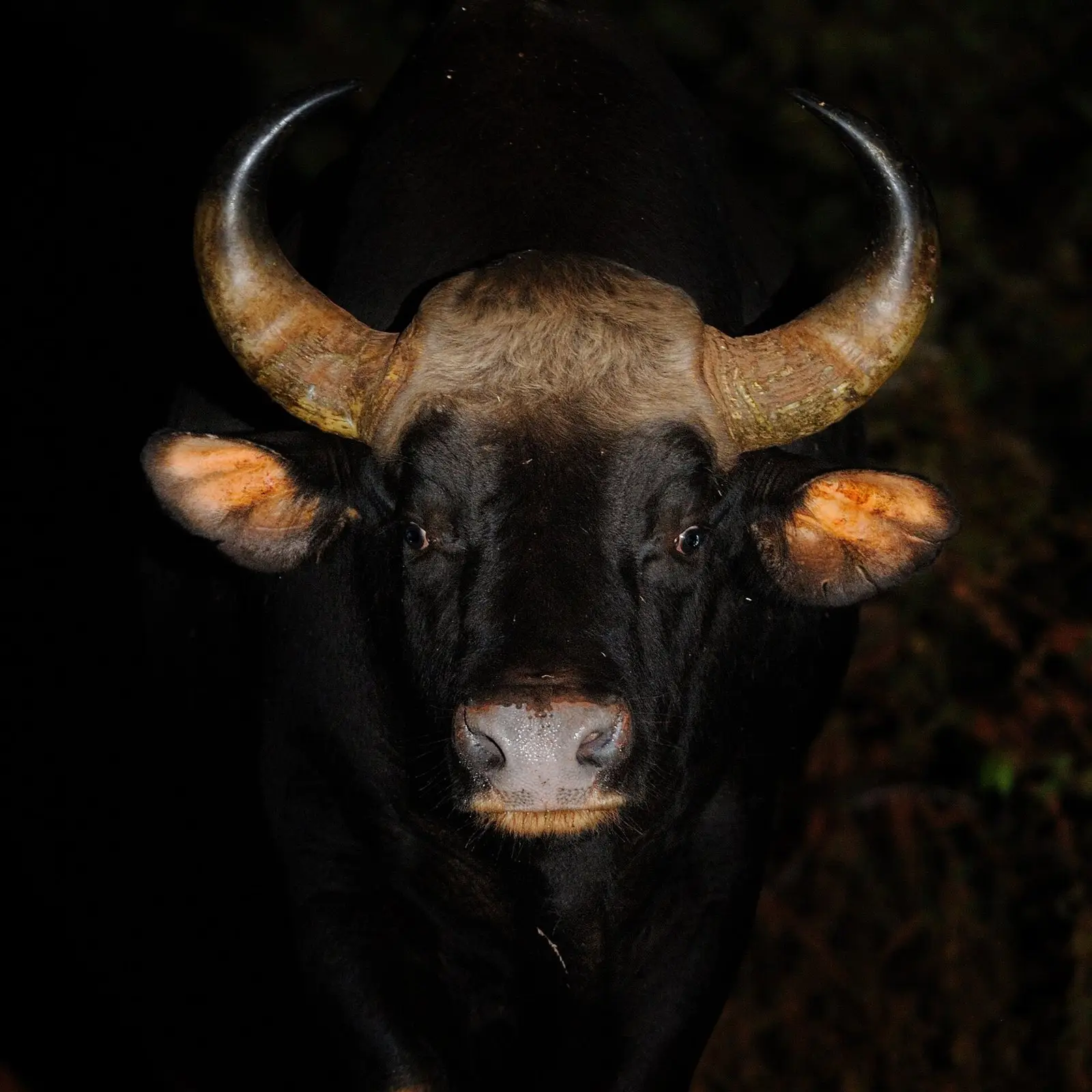
Gaur are the largest wild cattle in Asia: dark, heavy animals with pale “socks” on their lower legs and curved horns. A grown bull can weigh a tonne.
Khao Phaeng Ma was not always gaur country. The area was degraded by repeated fires and land clearing for farming until replanting began in 1994. At that time a single herd used the 5,000-rai site, staff told Thai PBS in January 2020. About 20 years later, gaur from Khao Yai began to move in.
Officials gave Thai PBS several reasons for the growth: hunting has stopped, the area is closed to people outside the visitor zone, there are no large predators, and water and grass are plentiful. Young secondary forest also has more undergrowth to eat than old forest. The count rose from about 100 to nearly 300 animals, living in three large herds. A Thai National Parks page cites a 2018 survey of about 300.
When to see gaur at Khao Phaeng Ma
Staff told Thai PBS that the herds usually come out at around 4pm to 5pm, and that one herd has numbered about 100 animals. Large herds are seen more often from June, in the rainy season, and less often in the dry months.
Thai National Parks gives a seasonal guide. From June to September, gaur may appear from about 2.30pm to 3pm. From October to January, the usual time is from about 5pm, close to sunset. From February to May, sightings in daylight are harder.
That makes the cool season a good time to go: the evenings are fresh, the grass is still green and the campground is at its best. It is also the busiest time, especially at weekends and on long holidays. About 20,000 people came to see the gaur in 2019, Thai PBS reported.
The Khao Phaeng Ma viewpoint
The Khao Phaeng Ma viewpoint is at the Khao Sung ranger station, between about 730 and 850 metres above sea level. It looks down over grassland and forest edge where the herds feed.
The grassland is a long way below, so bring binoculars or a camera with a long lens. In 2020, staff set up two telescopes that could see about 2 km, according to Thai PBS. There is also a separate sunset viewpoint looking over the ridges.
Gaur do sometimes come closer. In December 2020, an eight-year-old bull called Thong Dee, weighing about a tonne, grazed near the tents for more than 20 minutes before staff guided him back into the forest, the Office of Natural Resources and Environmental Policy and Planning reported. Keep well back if this happens and follow the rangers.
Rules for visitors
In January 2020 the DNP set clear zones at Khao Phaeng Ma: one for gaur viewing and one for camping. Thai PBS reported that visitors who go outside them are asked to leave, and that entering the closed area without permission can lead to legal action.
TrueID Travel lists the basic rules:
- Keep noise down so the animals are not disturbed.
- Never feed the gaur.
- Keep to the speed limit on the access road; wild animals cross it.
- Take your rubbish back down the hill.
A temporary electric fence of about 10 km runs around much of the area, Thai PBS reported, and some gaur still wander into nearby farmland. Drive slowly around Wang Nam Khiao after dark.
Fees and opening hours
Fees are collected at the service booth at the Khao Sung entrance. Love Thailand lists 30 baht for adults and 20 baht for children, 60 baht per car and 30 baht per motorcycle. Older listings from TrueID and Thai National Parks give 20 baht for Thai adults and 200 baht for foreign adults. Bring cash and confirm the current rate at the booth.
Love Thailand gives opening hours of 8am to 6pm daily; Thai National Parks gives 6am to 6pm. Arrive by mid-afternoon to find a place at the viewpoint before the herds come out.
Camping at Khao Sung
The campground is next to the ranger station, with toilets and basic services. Love Thailand lists camping at 30 baht per person per night with your own tent, and 200 baht per vehicle for a camper van or roof tent. Thai National Parks says no tents are rented out, so bring your own.
There are no restaurants at the viewpoint. Buy food and water in Wang Nam Khiao on the way up. Nights on the hill are cool from November to January, so pack a warm layer.
How to get to Khao Phaeng Ma from Bangkok
There is no public transport, so you need a car or a private driver. The usual route is Highway 304 to Wang Nam Khiao, then Road 3052 towards Ban Khlong Sai. Pass Ban Khlong Sai School and follow the uphill road to the Khao Sung ranger station. From Pak Chong, a route runs past the Lam Phra Phloeng reservoir to Ban Khlong Sai.
The last stretch is steep, and TrueID warns that it can be slippery in the rains. Allow extra time on holiday weekends, when the road up is busy. Many visitors stay at a resort in Wang Nam Khiao or Khao Yai and drive up for the afternoon.
For questions, the DNP hotline is 1362. The department’s website is dnp.go.th.
More wildlife near Bangkok
Khao Phaeng Ma pairs well with a night or two in the national park next door: see our Khao Yai wildlife watching guide. Gaur also graze with wild elephants on the grassland at Kui Buri, covered in our Kui Buri wild elephants guide. For forest further west, read our Kaeng Krachan wildlife guide, and find more days out in the Animals section.
Sources
- Thai PBS: Khao Phaeng Ma gaur rise to almost 300, plan to move some back to Khao Yai (20 January 2020, Thai)
- Thai PBS: national parks department sets visitor zones at Khao Phaeng Ma (15 January 2020, Thai)
- Office of Natural Resources and Environmental Policy and Planning: wild gaur grazes near the Khao Sung campsite (17 December 2020, Thai)
- TrueID Travel: Khao Phaeng Ma, Wang Nam Khiao, gaur viewing, fees and visitor rules (Thai)
- Love Thailand: Khao Phaeng Ma Non-Hunting Area, directions, opening times, fees and camping
- Thai National Parks: Khao Paeng Ma Non-Hunting Area, distances, viewing times by season and campsites
- Wikimedia Commons: gaur in Pang Sida National Park (hero photo)