Nang Loeng market walking guide: old cinema, temple and food stalls
Bangkok's old land market, a wooden cinema and a temple of stucco riddles.
On this page
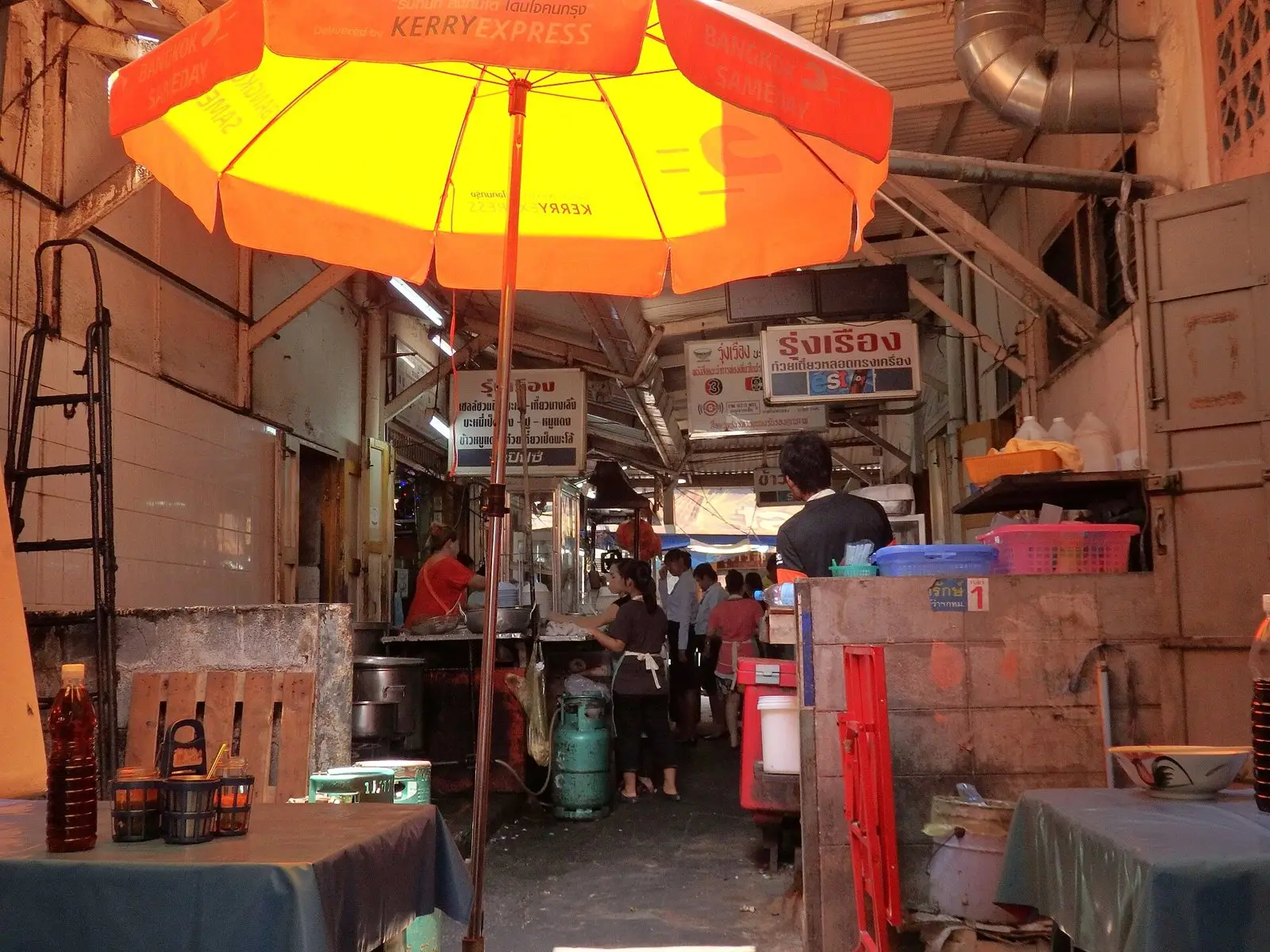
Nang Loeng market, which opened on 29 March 1900 on Nakhon Sawan Road, has traded for more than 125 years and is the heart of a small old-town neighbourhood in Pom Prap Sattru Phai district. Around it stand a wooden cinema from 1918, a temple known for its stucco riddles and lanes of long-running food shops. Below: the stops, opening hours, what to eat and how to get there.
Nang Loeng at a glance
| Stop | What it is | Open | Entry |
|---|---|---|---|
| Nang Loeng Market | Covered market of ready-to-eat food and Thai desserts | About 08:00-15:00; some stalls closed on Sundays | Free |
| Sala Chalermthani (Nang Loeng Cinema) | Wooden cinema, built 1918 | Only for special screenings | Screenings free |
| Wat Khae Nang Loeng | Neighbourhood temple founded in 1837 | – | – |
| Rajadamnern Stadium | Muay Thai stadium, first fight in 1945 | Fight nights daily | Ticketed |
A short history of Nang Loeng
Thai Wikipedia says the area was first called Ban Sanam Khwai, “buffalo field village”. It later took the name I-Loeng, after a kind of earthenware jar made by Mon potters, and became Nang Loeng under Prime Minister Plaek Phibunsongkhram.
The market opened in 1900 as Talat Mai, “the new market”, and Thai Wikipedia describes it as Thailand’s first land market, a market on dry land rather than on the water. Migrationology notes that the neighbourhood was home to residents from China, Vietnam, Cambodia and Laos, and that the market’s central food hall was renovated in 2006.
Today the subdistrict, officially Wat Sommanat, covers just 0.35 square kilometres between Khlong Phadung Krung Kasem and Ratchadamnoen Nok Avenue, with 6,672 residents in 2019.
Nang Loeng food: what to eat in the market
Nang Loeng market is now mostly a market of ready-to-eat food rather than fresh produce. Migrationology gives its hours as about 08:00 to 15:00, and some of the stalls below rest on Sundays. Thairath’s July 2026 round-up names these stalls:
- Monta’s Khanom Thuai Talai: small coconut custards in cups, 35 baht a box, Monday to Saturday 06:30 to 15:00. They sell out quickly.
- Mae Lek: a pla naem and sausage set, 50 baht, Monday to Saturday 10:30 to 14:30. Thairath says the stall has run for more than 70 years and is in its third generation.
- Mae Sa Ing: sakoo dumplings with pork, fish or shrimp, 50 baht a box, daily 08:00 to 15:00.
- Phetchaburi Khao Chae: rice in flower-scented iced water with side dishes, 40 baht a set.
- Mae Somchit’s Thai Desserts: toa paep, tako, khanom tom and other sweets, 20 to 45 baht.
- Mae Arun’s Khanom Tian: steamed parcels with peppery fillings, 12 baht each or 100 baht for eight.
Older guides, such as BK Magazine’s 2016 street food list, add long-running shops around the market: Jib Kee for roast duck and pork opposite the market, Nuea Toon Nang Loeng for braised beef noodles on Nakhon Sawan Soi 2, and Suwimol for kae noodles and fish balls in Trok Nang Loeng 2. Hours and prices in that list are ten years old, so check on the day.
Thai Wikipedia, citing the newspaper Kom Chad Luek, says the market is known for banana fritters, kluai khaek, sold by several vendors on the roads around it.
Sala Chalermthani: the Nang Loeng cinema
Sala Chalermthani. Known to most Bangkokians as the Nang Loeng cinema, this wooden hall at 35 Nakhon Sawan Road, on Soi Nakhon Sawan 6, was built in 1918. Time Out says it screened films for about 75 years before closing in 1993 and calls it the last surviving wooden cinema in Thailand.
The building does not run regular shows. The Thai Film Archive opens it for occasional free screenings: in May 2026 a “Classic Romance” weekend, and from 28 July to 1 August 2026 the five-night Cinematic Nang Loeng programme, with Thai classics from 1961 to 1997.
At those events, free tickets are handed out at the door from 15:00, films start at 16:00 and entry closes when the 250 seats are full, Thairath reported. The next screening dates are to be announced by the Thai Film Archive.
Wat Khae Nang Loeng: stucco riddles and murals
Wat Khae Nang Loeng. Officially Wat Sunthon Thammathan, this neighbourhood temple at 216 Phaniang Road was founded in 1837, according to Thai Wikipedia. Locals still call it Wat Khae.
Its ordination hall, a newer building that replaced an older one, has walls inlaid with mother-of-pearl at the front and back and houses the principal Buddha image, Phra Phuttha Sunthon Muni. In the cloister around it, stucco reliefs show scenes from the Buddha’s life, and stucco figures set out Dhamma riddles for visitors to puzzle over. Another revered image, Luang Pho Barami, sits under a large bodhi tree beside the hall. Dress modestly, as at any temple.
Rajadamnern Stadium and the walk south
Rajadamnern Stadium. On the southern edge of the neighbourhood, at 1 Ratchadamnoen Avenue, the Muay Thai stadium held its first fight on 23 December 1945 and has fight nights every day. Start times and tickets are in our Muay Thai in Bangkok guide.
From here it is a short walk to Khlong Saen Saep and Phan Fa Lilat Pier. Until 29 November 2026, the evenings can continue at the Golden Mount Fair at Wat Saket.
Suggested route
Allow two to three hours, and come on a weekday morning:
- Start at Nang Loeng market around 09:00 and eat your way through the stalls.
- Walk to Sala Chalermthani on Soi Nakhon Sawan 6 to see the wooden facade.
- Continue to Wat Khae Nang Loeng on Phaniang Road for the stucco riddles.
- Pick up banana fritters on the roads around the market.
- Head south past Rajadamnern Stadium towards Phan Fa Lilat Pier.
Pair the walk with our Khao San Road and Banglamphu guide, a short taxi ride west.
Getting there
- MRT: the nearest stations are Sam Yot (exit 1) and Hua Lamphong on the Blue Line; from either, Thairath advises taking a taxi or bus for the last part.
- Bus: routes 2, 5, 8, 44, 47, 60, 157, 509 and 511 stop at Talat Nang Loeng or near Phan Fa Lilat.
- Canal boat: take the Khlong Saen Saep boat to Phan Fa Lilat Pier, then walk about 800 metres. Thai Wikipedia also lists Nakhon Sawan Pier on the smaller Khlong Phadung Krung Kasem boat; check that service runs before relying on it. Our canal boat guide covers the main lines.
- On foot: Migrationology puts the market about a ten-minute walk from Democracy Monument.
- By car: parking is hard to find, and the cinema has none.
Tips for visiting
- Go early: popular stalls sell out before lunch, and much of the market closes by mid-afternoon.
- Sundays: some stalls rest, so a weekday or Saturday is the safer choice.
- A lived-in neighbourhood: keep voices down in the lanes and ask before photographing people.
Guided walks through the old town, including a food tour that stops at Nang Loeng market, are listed in our walking tours in Bangkok guide. More heritage walks and festivals are in the culture section.
Sources
- Wikipedia (Thai): Nang Loeng Market, opened 29 March 1900, Nakhon Sawan Road, name history, first land market, banana fritters, boat pier
- Wikipedia: Wat Sommanat subdistrict (Nang Loeng), Pom Prap Sattru Phai, borders and landmarks
- Thairath: Nang Loeng Market desserts and snacks, stalls, prices and hours (24 July 2026)
- Thairath: Cinematic Nang Loeng free screenings at Sala Chalermthani, ticket times, 250 seats, MRT, bus routes, boat and parking (23 July 2026, Thai)
- Time Out Bangkok: Sala Chalermthani (Nang Loeng Cinema), 35 Nakhon Sawan Road, built 1918, closed 1993 (Thai)
- Time Out Bangkok: Thai Film Archive screenings at the Nang Loeng cinema, free tickets from 15:00 (13 May 2026, Thai)
- Wikipedia (Thai): Wat Sunthon Thammathan (Wat Khae Nang Loeng), 216 Phaniang Road, founded 1837
- Migrationology: Nang Loeng Market, hours about 08:00-15:00, history and getting there
- BK Magazine: street food in Nang Loeng, long-running shops (23 February 2016)
- Wikipedia: Rajadamnern Stadium, 1 Ratchadamnoen Avenue, first fight 23 December 1945