Lampang with kids: elephants, horse carts, trains and chicken bowls
Elephants at the pond, a horse cart through the old town and a bowl to paint.
On this page
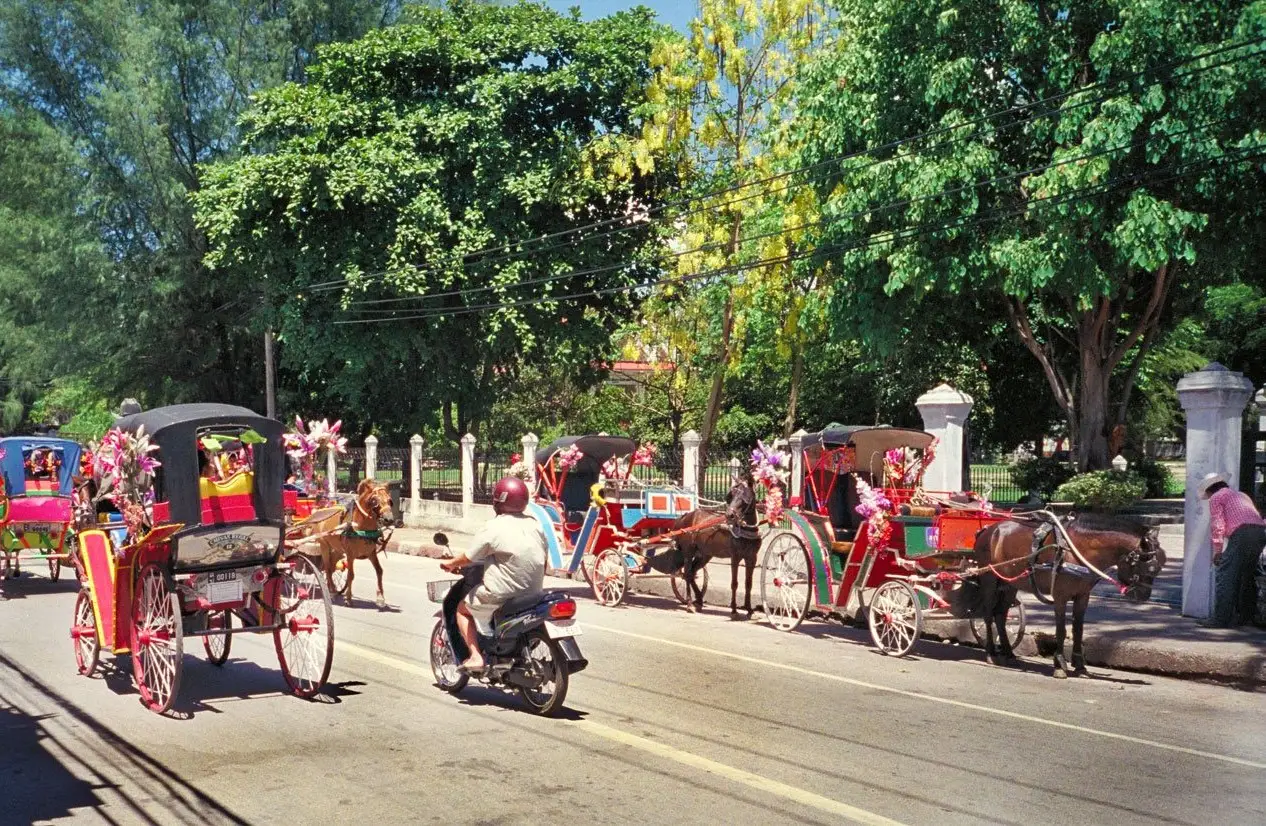
Lampang with kids makes an easy northern trip from Bangkok: five Northern Line trains a day stop at Nakhon Lampang station, and the daytime train arrives in the afternoon. The town is known for its brightly painted horse carts, and just outside it the Thai Elephant Conservation Center holds elephant bathing sessions twice a day. Add a ceramics museum where children can paint their own design, a hot-spring park and a train ride through Thailand’s longest railway tunnel.
For other trips north, see Chiang Mai with kids; for closer options, try weekend getaways from Bangkok with kids or browse the Family section.
Bangkok to Lampang by train
All the trains below leave from Krung Thep Aphiwat Central Terminal, according to the State Railway of Thailand timetable.
| Train | Leaves Krung Thep Aphiwat | Arrives Nakhon Lampang |
|---|---|---|
| 7 | 07:30 | 15:59 |
| 109 | 14:15 | 01:57 (next day) |
| 9 | 18:40 | 05:00 (next day) |
| 13 | 20:05 | 06:38 (next day) |
| 51 | 22:30 | 09:31 (next day) |
Train 7 is the daytime choice for families. Train 13 leaves after dinner and arrives in time for breakfast.
Heading home, train 102 leaves Lampang at 08:32 and reaches Krung Thep Aphiwat at 20:05, and train 8 leaves at 09:30 and arrives at 17:40. The overnight trains leave at 18:04 (train 52, arriving 05:10), 19:19 (train 14, arriving 05:55) and 20:24 (train 10, arriving 06:30). The railway’s 24-hour call centre is on 1690.
The station itself is worth a look. TAT notes that the first train reached Nakhon Lampang on 1 April 1916, when it was the country’s northernmost station, and that the building mixes Lanna and European styles.
Thai Elephant Conservation Center
The Thai Elephant Conservation Center is in Hang Chat district, north-west of town on the road to Chiang Mai. TAT’s directions are to go to the 37-kilometre marker and then on for the final two kilometres.
The best moment for children is bathing time. At 10:45 and 13:15 the elephants walk down to the pond with their mahouts, spray themselves with their trunks and get a scrub. Afterwards visitors can walk with them up the hill to the showground.
The educational demonstrations follow at 11:00 and 13:30 and last about 40 minutes, including the shuttle bus. Mahouts show the old teak-logging techniques and how an elephant follows 35 to 40 spoken commands, and some elephants paint during the show. The centre says that money from the sale of the paintings goes towards the elephants’ care.
At a glance: Thai Elephant Conservation Center
- Elephant bathing: daily at 10:45 and 13:15
- Demonstrations: daily at 11:00 and 13:30
- Admission: Thai visitors 100 baht for adults and 50 baht for children; foreign visitors 200 baht and 150 baht
- Getting round the site: the centre’s shuttle costs 25 baht for adults and 10 baht for children; driving your own car in costs 50 baht per vehicle
- Address: 272 Moo 6, Wiang Tan, Hang Chat, Lampang 52190
- Visitor centre: 054 829 333
For a hands-on half hour, the 10-minute bathing programme costs 500 baht per person: participants change into a mahout’s outfit, bathe and feed an elephant, then have their photo taken with it. A “tea with the elephants” set for two costs 500 baht and lasts an hour, with snacks, drinks and a photo with the elephants. The centre also sells elephant rides and longer mahout courses. Families who prefer to watch without touching or riding will find other options in our guide to elephant sanctuaries near Bangkok.
Dhanabadee Ceramic Museum: the chicken bowl story
Lampang is the home of the rooster bowl, the white bowl with a painted cockerel that was once found in kitchens across Thailand. The Dhanabadee Ceramic Museum in town tells its story and runs a painting workshop where children decorate their own piece, which takes 15 to 30 minutes and costs from 50 to 390 baht depending on the item. The museum can post finished pieces home.
The museum opens daily from 08:30 to 17:00, with guided rounds at 08:30, 09:00, 10:00, 11:00, 13:00, 14:00, 15:00 and 16:00. Children under 13 enter free. Thai adults pay 60 baht, students 30 baht and foreign visitors 100 baht, and each ticket comes with a discount coupon for the shop. It is at 32 Wat Chong Kham Phrabat Soi 1, Phrabat, Mueang Lampang (054 821 558-9, ext. 103).
Horse carts and the old town
Lampang is one of very few Thai towns where visitors can tour the sights by open-air horse-drawn carriage, TAT says. Stops can include the teak City Pillar Shrine, the teak house Ban Sao Nak and the railway station.
Ratchadaphisek Bridge over the Wang River makes a good stop on foot. TAT notes that the first bridge here, from 1894, was then the longest in Thailand, and the current one was finished in 1917. TAT also suggests the Kad Kong Ta street market for local snacks.
Day trips: temple, hot springs and a tunnel
Wat Phrathat Lampang Luang is about 18 kilometres south-west of town. Its open-sided teak chapel dates from the 1400s and is considered one of the oldest teak buildings in Thailand, according to TAT.
Chae Son National Park is known for spring-fed pools heated to 73°C at the source, where the steam makes a mist early in the morning. A six-level waterfall is one kilometre from the hot springs, and the park has camping and accommodation. TAT says it is easiest to reach by car or taxi.
Doi Khun Tan National Park is a trip for train fans. On the way north from Lampang, the railway passes through the Khun Tan tunnel, the longest in Thailand, and from Khun Tan station it is a walk of under a kilometre to the park, which has bungalows and camping. Train 7 reaches Khun Tan at 16:50; the overnight trains 9, 13 and 51 call there at 06:02, 07:37 and 10:29.
Where to stay with the elephants
The elephant centre has its own rooms, with breakfast included but show tickets not. At the Thai Elephant Learning Center Hotel, a twin or double room costs 1,000 or 1,200 baht, a four-bed room with two bunk beds 1,600 baht, and an extra bed 400 baht. Ten homestay houses, three wooden and seven modern, have fan rooms for two or three guests at 700 to 800 baht. Full payment is needed to confirm a booking.
Planning tips
- Book trains ahead for school holidays and long weekends.
- Time the elephants: arrive before 10:45 for the morning bathing, then stay for the 11:00 demonstration.
- Bring a change of clothes if children join the bathing programme.
- Combine the trip with Chiang Mai, about two hours further up the line on train 7.
Times and prices change, so check each venue’s page before you travel.
Sources
- State Railway of Thailand: Northern Line timetable, outbound
- State Railway of Thailand: Northern Line timetable, inbound
- Thai Elephant Conservation Center: educational demonstrations, admission and shuttle
- Thai Elephant Conservation Center: elephant bathing times
- Thai Elephant Conservation Center: 10-minute bathing programme
- Thai Elephant Conservation Center: tea with the elephants (Thai)
- Thai Elephant Conservation Center: Thai Elephant Learning Center Hotel
- Thai Elephant Conservation Center: homestay houses
- Dhanabadee Ceramic Museum: hours, tickets and painting workshop (Thai)
- TAT Newsroom: Living history in Lampang (September 2019)