Kanchanaburi with kids: Death Railway train, Erawan Falls, raft stays
Trains, waterfalls, floating rooms and the war history, with times and fees.
On this page
Kanchanaburi with kids works as a long weekend about 130 km west of Bangkok: a slow train along the Death Railway, waterfall pools at Erawan and Sai Yok, rooms that float on the river and museums that tell the railway’s wartime story. Times, fees and rules change, so confirm before you go.
For a shorter version of the Kanchanaburi stop, see weekend getaways from Bangkok with kids. For a night under canvas, see camping near Bangkok with kids.
Getting to Kanchanaburi from Bangkok
By train. The State Railway of Thailand (SRT) timetable lists two daily trains from Thon Buri station (Bangkok Noi) to Kanchanaburi and on to Nam Tok, the end of the line:
| Train | Thon Buri | Kanchanaburi | River Kwai Bridge | Tham Krasae | Nam Tok |
|---|---|---|---|---|---|
| 257 | 07:45 | 10:30 | 10:35 | 11:37 | 12:05 |
| 259 | 13:55 | 16:21 | 16:26 | 17:45 | 18:15 |
Back towards Bangkok, train 258 leaves Nam Tok at 13:00 and reaches Thon Buri at 17:40, and train 260 leaves Nam Tok at 05:20 and arrives at 09:35. A local train, 486, leaves Nam Tok at 15:30 and stops at Kanchanaburi at 17:26.
By bus. The Department of National Parks (DNP) says buses leave Bangkok’s Southern Bus Terminal for Kanchanaburi every 15 minutes from 04:00 to 20:30, taking about 2 hours 30 minutes. Buses also run from Mo Chit 2 between 05:00 and 19:00.
By car. The DNP puts Kanchanaburi at 129 km from Bangkok, about 1 hour 30 minutes. A car makes it much easier to combine the town with Erawan and Sai Yok in one trip.
The Death Railway train ride
For many children the train is the highlight. On Saturdays, Sundays and public holidays the SRT runs a one-day excursion train, according to the DNP. Train 909 leaves Hua Lamphong at 06:30, reaches Kanchanaburi at 09:38, the River Kwai Bridge at 10:08, Tham Krasae at 11:02 and Nam Tok at 11:30. Train 910 leaves Nam Tok at 14:25 and is back at Hua Lamphong at 19:30.
The SRT cancelled both trains on 3 and 4 October 2026 after flash floods in Kanchanaburi, so check the day’s running on the SRT’s 1690 line, which answers 24 hours.
What the line was. The Thailand-Burma Railway Centre (TBRC) describes a 415 km line built by the Imperial Japanese Army in 1942 and 1943 to supply its forces in Burma. It was laid from both ends at once, Nong Pladuk in Thailand and Thanbyuzayat in Burma, and joined in October 1943. More than 60,000 prisoners of war were sent to the project, and the TBRC gives about 240,000 Asian labourers as its most reliable estimate. Over 13,000 prisoners died, and around 100,000 Asian labourers.
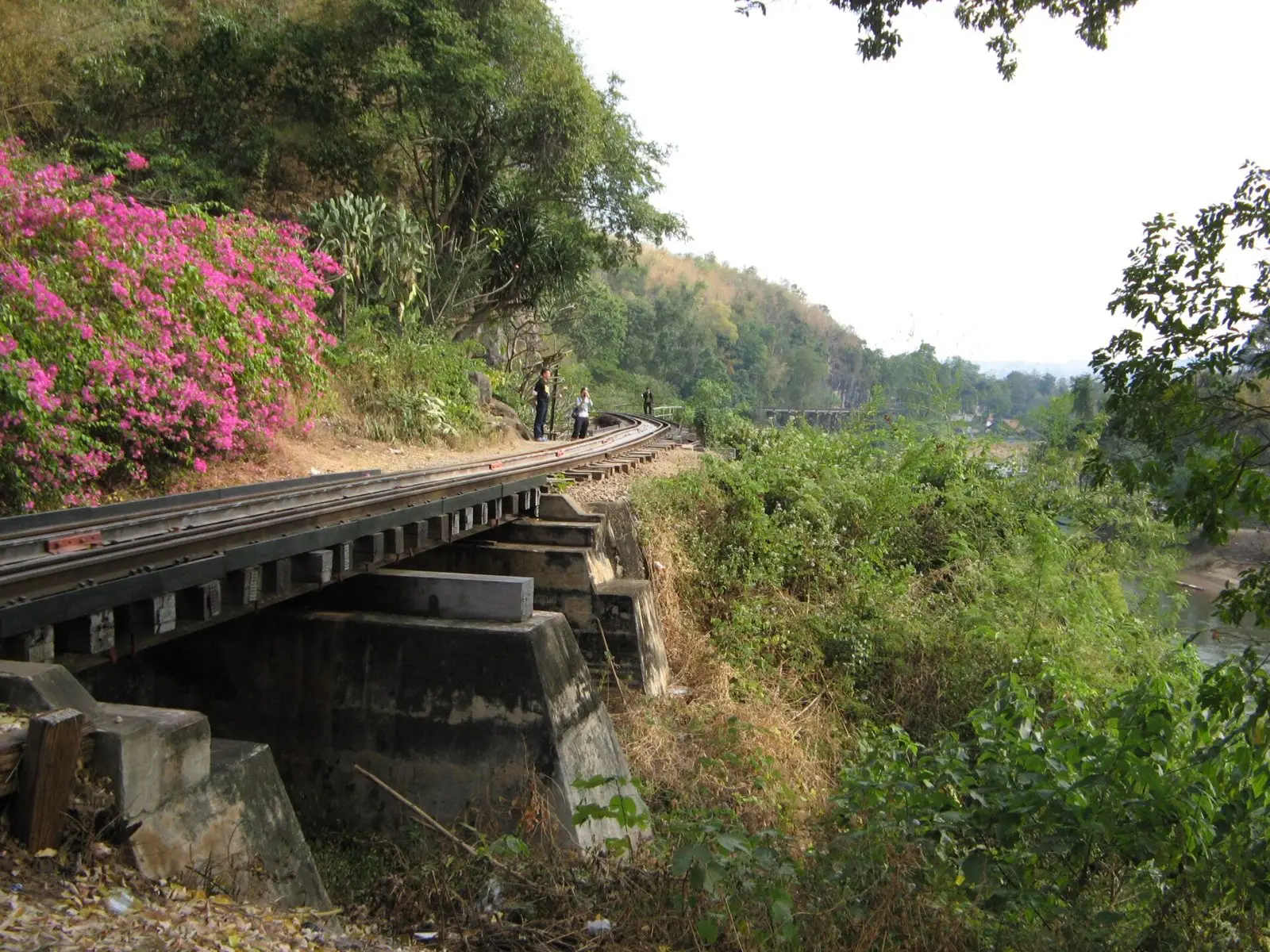
The TBRC says the Thai government bought the line in 1947 and by 1957 had reopened the section from Nong Pladuk to Nam Tok. That is the stretch the trains above still run on, crossing the bridge at River Kwai Bridge station and the wooden trestle along the cliff at Tham Krasae.
Erawan Falls with kids
Erawan National Park is about 70 km from Kanchanaburi town on Highway 3199, according to the DNP. Without a car, take Kanchanaburi bus No. 8170, which leaves every hour from 08:00 to 17:20.
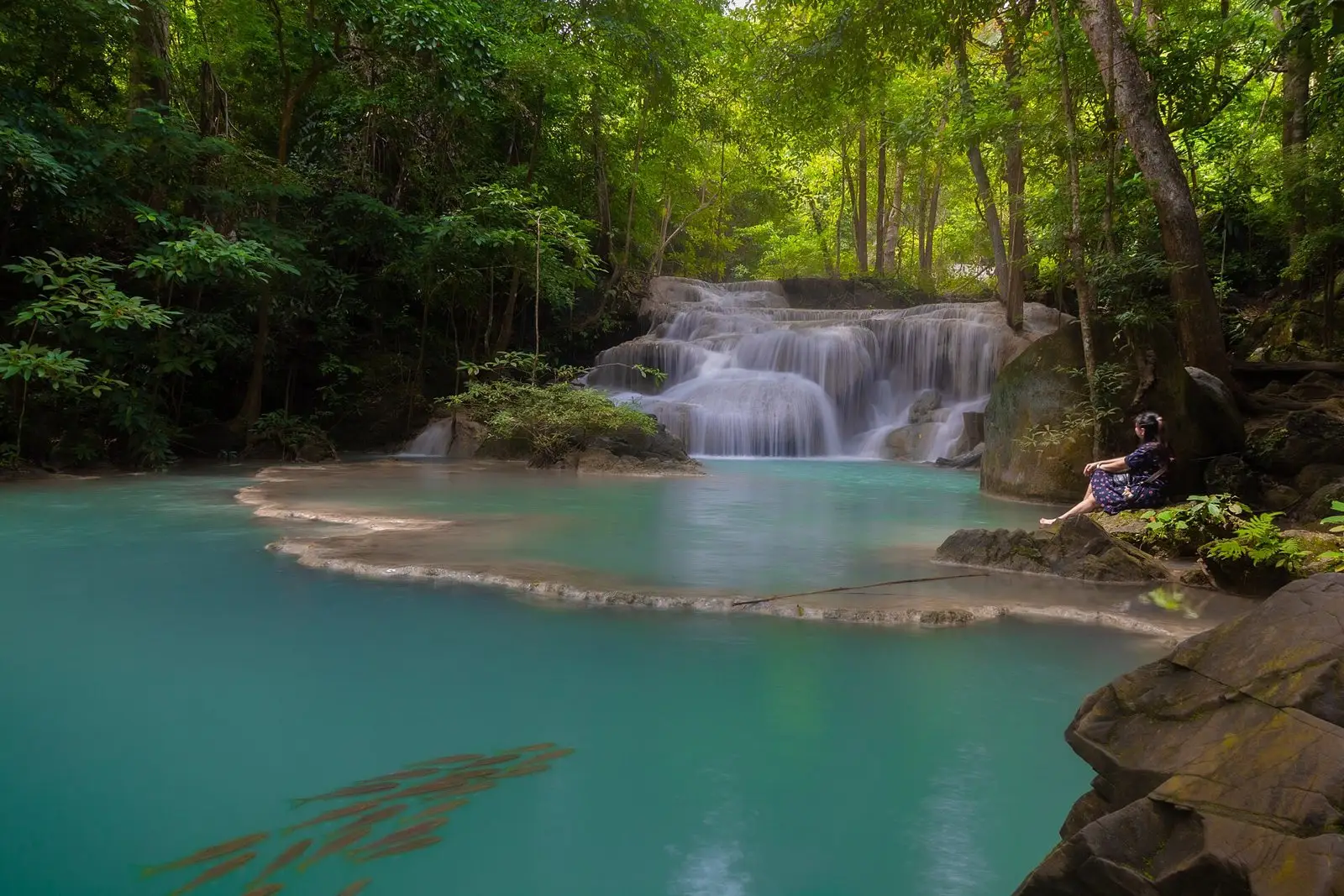
The park’s waterfall climbs in seven tiers. The walk from the trailhead to the top is nearly 1.5 km, with paths and footbridges up to the sixth tier and a scramble up rock to the seventh. Families with small children may prefer the lower tiers, where there are toilets for changing into swimwear.
Fees and hours. Fees as of June 2026: foreign adults 300 baht and children aged 3 to 14 150 baht; Thai adults 60 baht and children 30 baht; a car 30 baht. The park is open 08:00 to about 16:30 daily, with no entry after 15:30. The DNP asks visitors to carry the fee receipt inside the park.
Rules. Food is not allowed beyond the second tier, and drink bottles carry a 20-baht deposit, returned when the bottle comes back. The ponds are full of fish. Mobile signal reaches the first two tiers on all three networks, according to the DNP. The park’s phone numbers are 03 457 4222 and 03 457 4234.
Sai Yok National Park and the river
Sai Yok is further up the Khwae Noi River, past Nam Tok. Fees are the same as at Erawan, it opens 08:00 to 16:30, and camping costs 30 baht a person a night. Sai Yok Yai Waterfall is near the visitor centre and is fullest from June or July. Buses stop on Highway 323, about 3 km from the visitor centre.
Sai Yok Noi Waterfall, close to Nam Tok station, lies outside the park’s fee area, so there is no charge to see it. Lawa Cave, with large chambers about 500 m deep, is reached by long-tail boat or from the raft houses on the river.
Raft stays on the River Kwai
Two floating hotels near Sai Yok take families. Both are reached only by boat from Phutakien Pier; ask about life jackets and river swimming before booking.
The FloatHouse River Kwai. Floating villas of 90 square metres with a terrace and a private pier. The hotel says children of all ages are welcome: one child aged 0 to 6 stays free with breakfast in existing beds, and a child of 7 to 12 sharing beds pays only for breakfast. A room takes two adults and two children if the second child has the one extra bed allowed. Check-in is 14:00 to 18:00, with free shared long-tail boats every hour; a private boat outside those times costs 1,200 baht. By train, the hotel suggests Nam Tok station and a shared truck to the pier at about 150 baht a person.
River Kwai Jungle Rafts. Bamboo raft rooms with no electricity, internet or hot water. Rates are per person and include all meals and the boat, which takes about 15 minutes from Phutakien Pier or 40 minutes from Paksang Pier. Children under 12 may share their parents’ room, with the same 0-to-6 and 7-to-12 rules as above. Quiet hours start at 22:00.
War museums and memorials
The railway’s history is one of death, disease and forced labour, and the displays say so plainly. Parents may want to choose what suits their children.
Thailand-Burma Railway Centre. An air-conditioned museum on Jaokannun Road, beside the war cemetery. It opens daily from 09:00 to 16:00; adults pay 160 baht and children aged 7 to 12 pay 80 baht, as its page last updated in October 2022 states. Schools can book learning visits.
Kanchanaburi War Cemetery. Run by the Commonwealth War Graves Commission, it holds the graves of prisoners who died on the southern section of the railway. It opens Monday to Friday 08:00 to 17:00 and Saturday 08:00 to 12:00. The CWGC warns of snakes and an uneven pavement outside; a service entrance by the office has no steps, which helps with a pushchair.
JEATH War Museum. The Tourism Authority of Thailand lists it as open daily from 08:30 to 18:00, with admission at 30 baht.
Hellfire Pass Interpretive Centre. Run by the Australian Government, about 80 km from Kanchanaburi near Nam Tok. Entry is free, 09:00 to 16:00 daily, with a free audio guide in Thai, English and Dutch. The short walk to the memorial cutting is about 500 m, 45 minutes to an hour; the long walk, 2.6 km each way, needs good fitness. The centre closes on several holidays and for about three weeks each May for maintenance, so check its notices before you set out.
At a glance
| Place | Hours | Fee | Getting there |
|---|---|---|---|
| Excursion train 909/910 | Weekends and holidays | Ask the SRT on 1690 | Hua Lamphong 06:30 |
| Erawan National Park | 08:00-16:30, last entry 15:30 | Foreign 150-300 baht; Thai 30-60 baht | Bus 8170 from Kanchanaburi |
| Sai Yok National Park | 08:00-16:30 | Foreign 150-300 baht; Thai 30-60 baht | Highway 323 |
| Thailand-Burma Railway Centre | Daily 09:00-16:00 | Adults 160, children 7-12 80 baht | Kanchanaburi town |
| Hellfire Pass | Daily 09:00-16:00 | Free | Near Nam Tok |
Tips for the trip
Ride one way, drive the other. The trains run slowly and only a few times a day, so many families take the train out and a bus or car back.
Pack for water and rock. Waterfall pools mean swimwear, a towel and shoes that grip; the upper Erawan tiers and the Hellfire Pass walk need closed shoes.
Add the elephants with care. Kanchanaburi also has a hands-off elephant rescue centre with no riding; see elephant sanctuaries near Bangkok. For shorter outings, see day trips by train or boat and the Family section.
Sources
- State Railway of Thailand: Southern Line timetable, outbound (Thon Buri and Hua Lamphong to Nam Tok)
- State Railway of Thailand: Southern Line timetable, inbound (Nam Tok to Thon Buri and Hua Lamphong)
- Bangkok Biz News: SRT cancels excursion trains 909/910 on 3-4 October 2026 (Thai)
- Department of National Parks: Erawan National Park, getting there and services
- Thai National Parks: Erawan National Park fees and rules (as of June 2026)
- Thai National Parks: Sai Yok National Park fees, waterfalls and caves
- Thailand-Burma Railway Centre: brief history of the railway
- Thailand-Burma Railway Centre: visitor information (updated 31 October 2022)
- Commonwealth War Graves Commission: Kanchanaburi War Cemetery
- Hellfire Pass Interpretive Centre (Australian Government): visitor FAQ
- Tourism Authority of Thailand: the JEATH War Museum
- The FloatHouse River Kwai: how to get here and boat transfers
- The FloatHouse River Kwai: hotel policies, children and extra beds
- River Kwai Jungle Rafts: FAQs
- River Kwai Jungle Rafts: hotel policies, children and extra beds